
Japan F-X
Country of Origin: Japan, United Kingdom, Italy
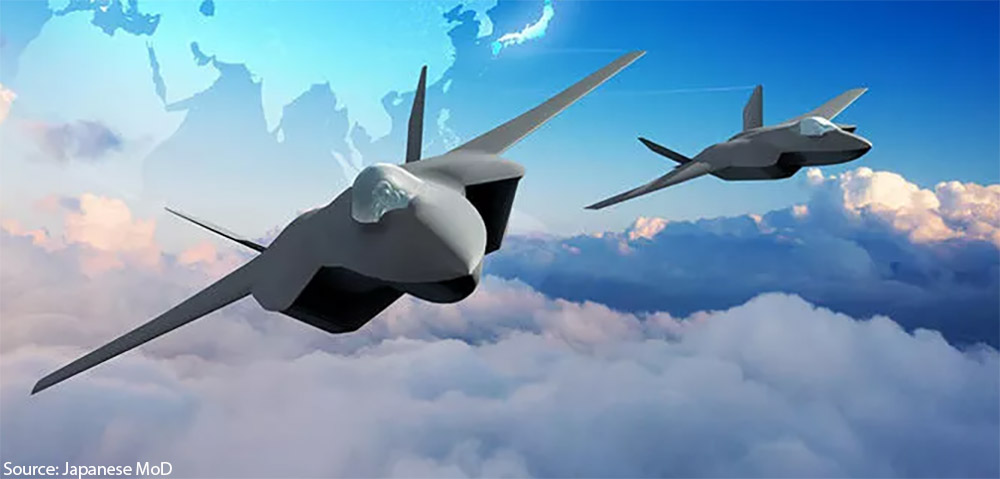
description
The Japanese F-X fighter program (also known as the F-3) began as a Japanese-led program to replace the country's F-2s (scheduled for retirement in 2035). The program was prompted by a U.S. ban on exports of F-22 Raptors in 1997 to safeguard U.S. technology. As a result, Japan’s Ministry of Defense has been researching fighter jet technology since 2009.
However, on Dec. 9, 2022, the governments of Japan, the United Kingdom and Italy announced the Global Combat Air Program, a joint development project for a sixth-generation fighter aircraft that would replace the United Kingdom and Italy’s Eurofighter Typhoon and the Japanese Air Self-Defense Force’s Mitsubishi F-2.
The F-X's design is larger than the F-22, reflecting its intended operational range and superior payload capacity, while maintaining a stealthy profile that competes with advanced systems like the F-35.
Design and Structural Innovations
The F-X is a twin-engine jet aircraft capable of mounting six internal weapons.
The F-X employs advanced materials and innovative design methodologies to optimize weight and structural integrity. One key feature is the extensive use of composite materials bonded through adhesive molding techniques, which eliminate the need for traditional fasteners, leading to a lighter, more durable airframe.
Additionally, the F-X departs from older fighter designs by adopting electric actuators in place of traditional hydraulic systems. This shift not only reduces the complexity of the internal systems but also provides greater flexibility in design, supporting the incorporation of stealth characteristics by simplifying the integration of internal components like the weapons bay and air-intake ducts.
Avionics and Sensor Suite
The F-X integrates a suite of advanced sensors designed to enhance both offensive and defensive capabilities. Key components include an Active Electronically Scanned Array (AESA) radar, a passive radio frequency (RF) sensor, and an infrared search and track (IRST) system. The AESA radar is an upgraded version of the J/APG-2 radar used in the F-2, delivering enhanced range, resolution, and tracking precision. Additionally, the RF sensor offers significant improvements in detecting and tracking stealth targets.
The aircraft will feature an RF self-defense system capable of jamming hostile sensors and missile systems through advanced Electronic Support Measures (ESM) and Electronic Countermeasures (ECM).
Stealth Capabilities
The aircraft features serpentine air ducts and an internal weapons bay, which conceal weapons and reduce the aircraft’s exposure to radar detection. Electromagnetic wave absorbers, crafted from carbon-based materials, are integrated around key sections of the aircraft, particularly the engine and air-intake ducts, to significantly reduce RCS and achieve stealth levels comparable to leading fighters in its class.
Plasma-stealth antenna technology is also employed, creating a temporary plasma field around the aircraft to deflect radar waves and improve the fighter's overall stealth characteristics during operations.
Propulsion
The F-X is powered by two IHI Corporation’s XF9 engine, a key component in the aircraft’s design, providing high thrust and electrical power for its avionics. The XF9 engine is capable of generating over 20 tons of thrust and incorporates three-dimensional thrust vectoring nozzles to enhance maneuverability and overall performance, especially during combat.
The XF9 is tailored for low drag and high-efficiency operation, with a highly efficient combustion process and reduced inlet size, optimizing the design for internal weapon storage.
Armament and Offensive Systems
The aircraft will be equipped with next-generation air-to-air and anti-ship missiles, including the ASM-3, which is developed to replace older systems like the ASM-1 used by its predecessor, the F-2. Additionally, a microwave weapon system is integrated into the F-X, capable of disrupting incoming missile threats. This system is powered by the aircraft's AESA radar and utilizes electron tube amplifiers for efficient miniaturization and high-frequency operation.
Unmanned Aerial Vehicle (UAV) Integration
To further enhance the F-X’s operational capabilities, Japan plans to integrate Combat Support Unmanned Aircraft (CSUA) alongside the fighter. These drones will serve as “loyal wingmen,” capable of conducting various missions such as reconnaissance, targeting, and air defense. The CSUA will operate in coordination with the F-X, with variants specialized in sensor reconnaissance and active combat operations, including intercepting missiles aimed at the parent fighter. The development of these UAVs is expected to reach completion by the 2030s, significantly enhancing the operational flexibility and survivability of Japan’s air fleet.
status
In development. The aircraft is being developed jointly by the governments of Japan, Italy, and the United Kingdom. It is expected to enter service in 2035.
Early Development (2009-2019)
- 2009: Japan begins considering the development of an indigenous stealth fighter after being denied access to the U.S. F-22 Raptor due to export restrictions.
- 2011: Japan selects the F-35 Lightning II as its next mainstay fighter but continues research into advanced fighter technologies.
- 2016: In April the X-2 Shinshin, an experimental stealth demonstrator developed by Mitsubishi Heavy Industries (MHI), completed its first flight. This aircraft serves as a testbed for future stealth fighter technology.
- 2017:The Japanese MOD formally initiated a feasibility study for a domestically developed next-generation fighter. Various configurations and technologies were assessed.
- 2018: The Japanese Ministry of Defense (MoD) formally announces the F-X program as the next-generation air superiority fighter to replace the aging F-2 fleet by the 2030s.
- Japan issued a third request for information on design proposals for a new fighter based on existing aircraft, reported Reuters on March 7, 2018. Unlike the two previous RFIs, this was sent only to foreign companies in the U.S. and Europe.
- In response, Lockheed Martin offered an upgraded version of the F-22, incorporating and avionics suite of the F-35, reported the Nikkei (Tokyo) on Aug. 22, 2018. Lockheed estimated the unit cost for the jet at US$110.1 million. Reuters reported on July 6, 2018, that Japan had also received offers from Boeing for the F/A-18E/F Super Hornet and BAE Systems for the Eurofighter Typhoon.
- Japan rejected the designs proposed by Lockheed Martin, Boeing and BAE Systems, reported the Mainichi Shimbun (Tokyo) on Oct. 4, 2018. Officials from the Acquisition, Technology & Logistics Agency (ATLA) said the designs did not meet Japanese requirements, according to a Reuters article published on March 27, 2020. The decision put Mitsubishi Heavy Industries in the lead to secure the contract despite not having submitted a proposal.
- 2019: mid-September 2019, Japan began testing XF-9-1 low-bypass turbofans developed by Ishikawa Heavy Industries. These can reportedly generate 11-12 tons dry thrust, or 15-16.5 tons ‘wet’ (dumping fuel into the afterburners) and tolerate 1,800 degrees Celsius of heat. While the F-22’s two F119 turbofans generate 13 tons dry and 17.5 wet thrust, the XF-9 is a half-meter shorter and 30 centimeters slimmer than the F-119, leaving more room for internal weapons.
2020
On April 1, 2020, the ATLA established a dedicated team to develop the F-X, reported the Japan Times (Tokyo). The team was led by a Japan Air Self-Defense Force (JASDF) major general and consisted of 30 JASDF officers, engineering officials and others. Subaru also announced that it would establish a technology development center to support the F-X program.
In July 2020, The Japanese MoD officially announced its decision to develop the F-X fighter domestically while seeking collaboration with foreign defense companies.
Japan issued a request for information (RFI) for combat aircraft designs on Sept. 16, 2020, reported Flight Global on Nov. 5, 2020. According to the ATLA, only BAE Systems, Boeing and Lockheed responded before the deadline. Lockheed's bid included Northrop Grumman. The ATLA said that Mitsubishi Heavy Industries would conduct conceptual design reviews to identify the best fighter configuration.
On Oct. 30, 2020, the Japanese MoD awarded Mitsubishi Heavy Industries (MHI) the prime contractor role for the F-X program, responsible for design, development, and production.
In December 2020, the Japanese MoD decided to collaborate with Lockheed Martin as an integration support company.
2021
The U.K. and Japan signed a memorandum of collaboration (MOC) on Dec. 19, 2021, that would require BAE Systems to engage with Japanese companies, including MHI, to potentially develop subsystems for the F-X jet, reported Jane's on May 27, 2022.
Dec. 22, 2021, Japan signed an agreement with the UK to collaborate on engine development, with Rolls-Royce and Mitsubishi Heavy Industries (MHI). Italy's Avio Aero later joined the program. Rolls-Royce reported the UK was investing an initial £30 million in planning, digital designs and innovative manufacturing developments and an additional £200 million was expected to go towards a full-scale demonstrator power system.
2022
Defense Minister Lorenzo Guerini expressed interest in the possibility of Italy joining the F-X program during talks with his Japanese counterpart, Nobuo Kishi, reported Nippon.com on April 13, 2022.
The Sankei Shimbun reported on May 14, 2022, that Japan decided to partner with BAE Systems for the F-X development program. The aircraft was supposed to be developed by Mitsubishi Heavy Industries with assistance from Lockheed Martin. However, talks on how to carry out the development work ran into roadblocks. Tokyo subsequently decided to team with BAE Systems for the project.
Japan and the U.K. announced their intent to cooperate on the F-X program at the Farnborough Air Show in England on July 18, 2022, reported Popular Mechanics. The countries had first agreed to exchange information on their fighter programs in 2017.
On Dec. 9, 2022, the governments of Japan, the United Kingdom and Italy announced the Global Combat Air Program, a joint development project for a sixth-generation fighter aircraft that would replace the United Kingdom and Italy’s Eurofighter Typhoon and the Japanese Air Self-Defense Force’s Mitsubishi F-2. On the same day, the U.S. Dept. of Defense and Japanese Ministry of Defense announced that the sides would work together on defense research, including autonomous systems that could complement Japan's next-generation fighter, among other platforms
2023
Business Insider reported on Jan. 3, 2023, plans for the F-X included fiber-optic controls, VR-style helmet-mounted displays and advanced networking and sensor capabilities. Japan was also developing drones, known as Combat Support Unmanned Aircraft, to be operated by the F-X pilot as sensor-laden scouts or armed combat platforms.
On March 2, 2023, the U.K. Ministry of Defense announced that it had agreed to a partnering feasibility study with Saudi Arabia to determine how the partners could best work together in the area of combat aircraft. Saudi Defense Minister Khalid bin Salman had indicated that Riyadh was interested in participating in the British-led Future Combat Air System (FCAS) program, which would merge the British Tempest and Japanese F-X advanced fighter programs. (Saudi Arabia did not move forward.)
On Dec. 14, 2023, Japan, the UK, and Italy signed a treaty formalizing their cooperation under GCAP. Mitsubishi Heavy Industries, BAE Systems, and Leonardo would serve as the primary industrial partners.
2024
On March 18, 2024, Defense News reported Japan was adopting a new security policy, relaxing export restrictions, and allowing for limited exports of the F-X fighter. Prime Minister Fumio Kishida argues that restricting exports to only GCAP partners could hinder the program’s success and limit Japan’s ability to modernize its air force. To address concerns, the ruling coalition agreed on strict conditions: exports will require Cabinet approval, be limited to countries with existing defense ties to Japan, and be prohibited for nations engaged in active conflicts.
On July 21, 2024, the three GCAP government partners and their lead industry partners showcased a concept model of the F-X at Farnborough International Airshow. The model featured a much more evolved design with a wingspan larger than previous concepts to improve aerodynamics.
On Dec.13, 2024, BAE Systems announced it reached an agreement with Leonardo (Italy), and Japan Aircraft Industrial Enhancement Co Ltd (JAIEC), to form a new company under a business joint venture for the Global Combat Air Program. The new joint venture will be accountable for the design, development and delivery of the next-generation combat aircraft and will remain the design authority for GCAP for the life of the product, which is expected to go out beyond 2070. BAE Systems, Leonardo, and JAIEC will each hold a 33.3% shareholding in the new joint venture.
builders
Mitsubishi Heavy Industries, Tokyo, Japan ( Prime Contractor)
BAE Systems (U.K.)
Leonardo (Italy)
characteristics
WEIGHTS | |
Empty | 30,870 lb (14,000 kg) |
Maximum takeoff | 56,220 lb (25,500 kg) |
DIMENSIONS | |
Length | 65 ft 0 in (19.81 m) |
Width | 45 ft 5 in (13.87 m) |
Height | 16 ft 4 in ( 5.00 m) |
PROPULSION | |
Engine | 2 x XF9-1 turbofans |
PERFORMANCE | |
Speed | 1,460 mph (2,350 kph) |
Range | 1,860 mi (3,000 km) |
Ceiling | 65,620 ft (20,000 m) |
Rate of climb | 45,000 ft/min (13,870 m/min) |
ARMAMENT | |
Missiles | ASM-3 anti-ship |
Bombs | laser-guided |
Directed energy | microwave |
issues and notes
Global Combat Air Program (GCAP)
The Global Combat Air Program (GCAP) is a collaborative international initiative led by the United Kingdom, Japan, and Italy to develop a sixth-generation stealth fighter. The announcement of this program was made on December 9, 2022, with a formal agreement signed in Japan in December 2023. The goal of the program is to integrate the previously distinct sixth-generation fighter projects: the UK's BAE Systems Tempest, Italy’s Tempest initiative, and Japan's Mitsubishi F-X program. A shared headquarters and industrial hub will be located in the UK, with Japan providing the first CEO and Italy taking the lead for the business entity's head.
The program is set to officially begin development in 2025, with the first prototype expected to fly by 2027. Full operational deployment of the aircraft is targeted around 2035. The new aircraft aims to replace the aging Eurofighter Typhoon used by the Royal Air Force and the Italian Air Force, as well as the Mitsubishi F-2, which serves in Japan’s Air Self-Defense Force. Additionally, the fighter will be available for export, helping to lower its unit costs.
GCAP is designed to be an equal partnership between the three nations, with respective roles assigned to each country's major contractors. In the UK, BAE Systems will be the prime contractor overseeing the airframe, Rolls-Royce will provide the engines, Leonardo's UK division will handle electronics, and MBDA UK will be responsible for the weaponry. Japan's Mitsubishi Heavy Industries will take the lead, with IHI Corporation supplying the engines and Mitsubishi Electric managing the electronics. Italy’s Leonardo S.p.A. will act as the prime contractor, while Avio Aero works on the engines and MBDA IT focuses on missile systems. In 2024, the specifics of the development and cost-sharing arrangement among these companies will be finalized, with production planned to start around 2030 and the first aircraft delivered by 2035. Potential partnerships with Sweden, Saudi Arabia, and Germany were explored.
In December 2022, just two weeks after the GCAP announcement, Japan and Sweden signed an agreement to enhance defense ties and facilitate the transfer of defense technology. There was initial speculation that Sweden might join GCAP to replace its Saab JAS 39 Gripen fighter. However, by March 2023, it became evident that Sweden's fighter program did not align with the views of the UK and Italy. In December 2023, Swedish officials confirmed that they would not select a replacement fighter until 2031. Meanwhile, Japan opposed Saudi Arabia's involvement in the program, primarily due to security concerns surrounding sensitive technologies and the Saudis’ demands for a larger role in the industry. Nevertheless, Japan is revising its stringent defense export regulations to enable the transfer of finished products to third-party nations, helping to reduce procurement costs.
program cost
The F-X, set to be developed by Mitsubishi, is expected to be built at a cost of over 5 trillion yen ($48 billion).
In September 2020, the Japanese Defense Ministry requested US$555.8 million for the F-X program and an additional US$113.6 million for research and development into fighter technology, such as stealth designs and materials, AESA radars, mission systems integration and afterburning turbofan engines, reported Defense News.