
MANTAS Series
Country of Origin: USA
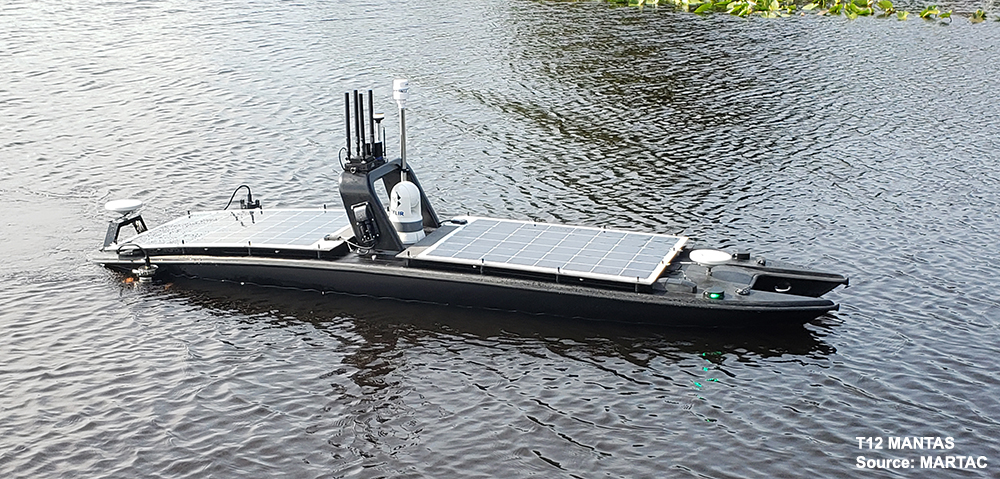
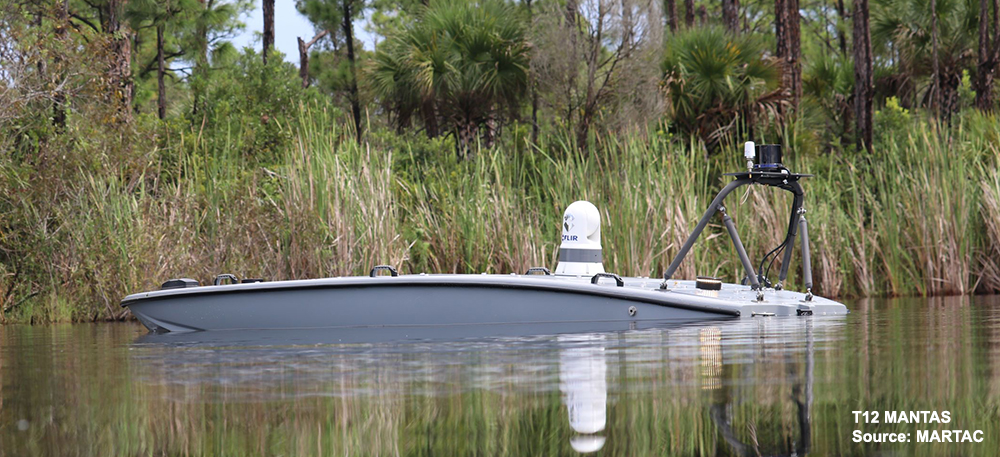
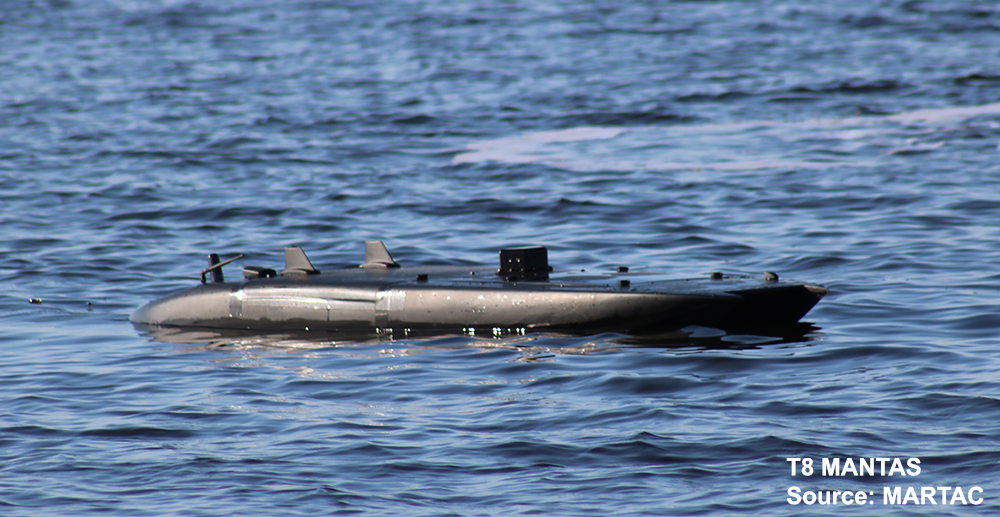
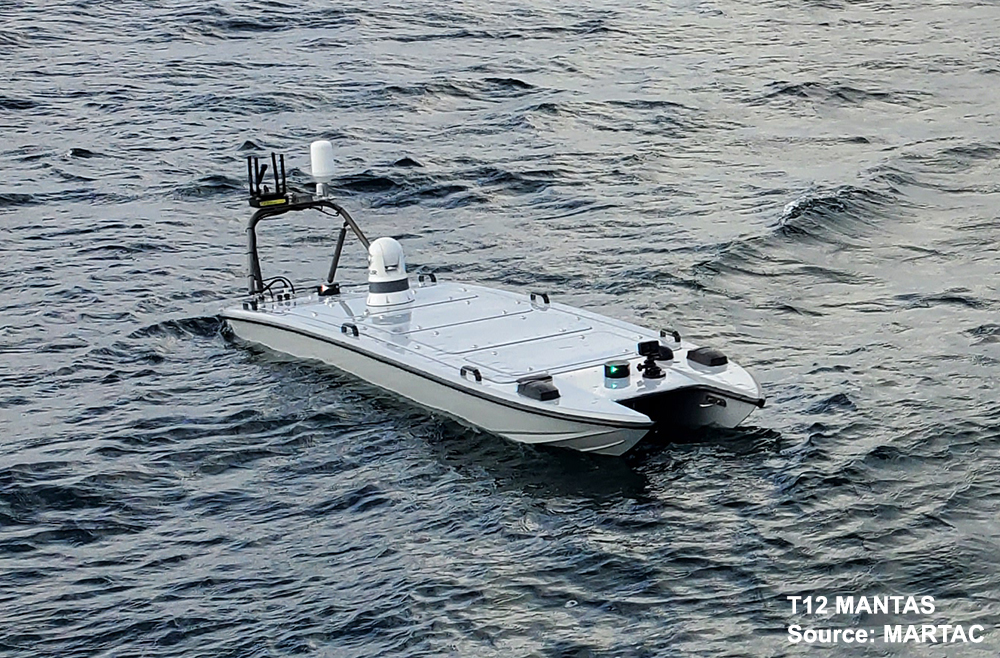
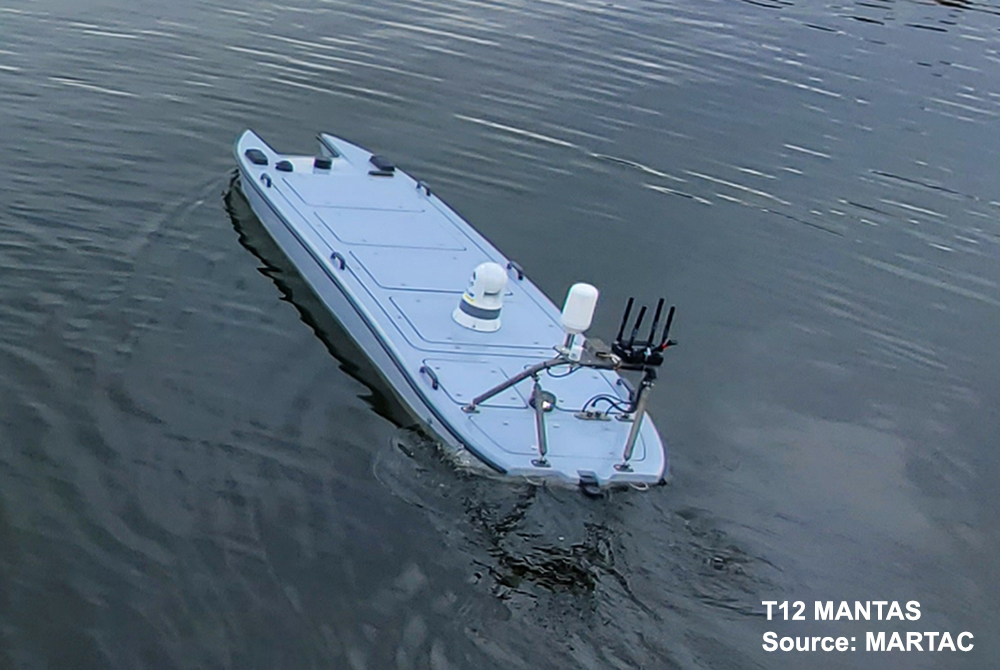
description
The Man-portable Tactical Autonomous System, or MANTAS is a series of scalable multirole uncrewed surface vehicles (USVs) developed by Maritime Tactical Systems (MARTAC). Marketed to both civilian and military customers, the MANTAS series can be used for maritime patrol, search-and-rescue, surveillance, mine-countermeasures, fleet training, communications, environmental monitoring and infrastructure inspection. The MANTAS series has versatile deployment options and can be launched from shore, ship or small boat with supporting recovery and launch equipment.
MARTAC has demonstrated swarm capabilities for several linked MANTAS units. This technique has been applied to hydrographic and bathymetric surveying, using several units to effectively scan large areas of subsea terrain.
MANTAS units operate in autonomous, semi-autonomous or fully manual modes. When fully manual, the units receive direction from a dedicated ground control station where an operator can command and oversee multiple units from a laptop, tablet or smartphone. In semi-autonomous mode, an operator can assign waypoints and heading to the linked unit or units, which will follow the orders through. When operated autonomously, the MANTAS units follow pre-programmed autonomous track, integrating waypoint navigation. While in semi-autonomous and autonomous operable modes, the operator can still choose to intervene at any point.
HULL: These USVs are designed with a sleek, hydrodynamic carbon-fiber catamaran hull, contributing to enhanced speed and maneuverability. They are designed for low-observability and minimized radar cross section and both noise and thermal signatures. The T12 features four identical hatches on its deck.
ENGINEERING: The T6, T8 and T12 models are all fitted with a twin screw all-electric powertrain. Cruise speeds range between 8 to 20 knots, while cruising range (variant-dependent) vary between 50 nm (90 km) to 60 nm (110 km). T8 and T12 units can be fitted with optional solar panels on the deck to extend their cruising range.
Oakridge Global Energy Solutions provides the USVs’ high-performance batteries.
ARMAMENT: The MANTAS series is designed to be unarmed.
SENSORS/ELECTRONICS: The TASKER command and control system is shared by all USVs of this series as well as the MARTAC Devil Ray USVs. The MANTAS series units each have an automated self-righting system to correct its orientation in case of emergency or difficult operational conditions. The USVs high-definition video sensors offer 360-degree coverage. A variety of possible sensors and electronic systems can be integrated modularly based on client preference (See Variants section).
status
In production.
Following Maritime Tactical Systems’ (MARTAC) incorporation in 2011, the company pursued the development of scalable unmanned surface vessels (USVs), originally for hydrographic and surveying purposes.
Navy Recognition reported on April 11, 2017, that MARTAC had displayed their 6-ft MANTAS T6 model at the Sea-Air-Space defense expo in Washington, DC.
The company announced on Oct. 20, 2017, it had teamed with Ameren to operate a MANTAS Mobile Inspection Platform USV in an unmanned inspection of the Keokuk Renewable Energy Center and Dam, in Keokuk, Iowa. The test involved the successful navigation of the river and multibeam sonar scans of the dam, powerhouse, ice break and bay using an integrated Teledyne Reson T20 multibeam echosounder. Following the demo, MARTAC announced the commercial launch of the MANTAS mobile inspection platform.
The MANTAS system’s major milestone was the debut of the T-12 model at the Surface Navy Association Symposium in DC in January 2018. These larger models, with significantly greater payload capacity form the core of marketable MANTAS designs.
In 2019, following a three-month pilot study of the MANTAS T12, the British Ministry of Defense awarded MARTAC a contract for five units along with sensors, spare parts and support work worth US2.4 million (GBP£1.8 million), the Ministry announced in January 2020. The 2019 pilot contract reportedly saw the U.K lease two T12 model for suitability testing. Three of the five contracted USVs were planned for use in the Royal Navy, with the remaining two going to the Strategic Command.
Henriksen AS and MARTAC established a global strategic partnership to develop and collaborate on complex USV launch and recovery systems for the MANTAS series, per a Henriksen press release on Sept. 19, 2020.
On Sept. 24, 2020 MARTAC announced a teaming agreement with the U.K-based MSubs Ltd. for further development of unmanned technology. Under the deal, MARTAC would work to integrate MSubs subsidiary Marine AI’s artificial intelligence software into the MANTAS TASKER command and control system. Additionally, MSubs would support global sales of the MANTAS system, with an emphasis on the U.K and E.U.
Maritime Executive reported on Aug. 26, 2021 that MARTAC had signed a partnership agreement with Subsea Europe Services on the delivery of unmanned and autonomous marine survey platforms. The agreement would see the MANTAS T12 integrate Subsea Europe Services’ hydroacoustic survey system, with the first units expected from 2022.
MARTAC announced a strategic alliance with Telestra Technologies to market the MANTAS and Devil Ray USV families to the hydrographic surveying market. Telestra would provide the necessary sensor kits, while MARTAC would supply the platforms. The announcement emphasized the value of MANTAS swarms in conducting effective hydrographic surveys.
During its New Horizon exercises on Oct. 26, 2021, the U.S. Navy’s 5th Fleet successfully integrated the MANTAS T12 USV alongside manned patrol vessels in the Arabian Gulf near Bahrain. This marked the first ever integration of USVs with manned ships in the 5th Fleet’s history.
Two MANTAS T12 USVs were operated by the Australian navy as part of its multinational Autonomous Warrior exercises held in Jervis Bay in May 2022.
Bruce Hanson, MARTAC CEO, stated that over 30 MANTAS USVs have been operated in Australia, Bahrain, New Zealand, the UK and the US.
builders
Maritime Tactical Systems (MARTAC), Melbourne, Fla.
characteristics
 WEIGHTS
   Total
      T6                    56 lb (25.4 kg) + payload
      T8                   125 lb (56.7 kg) + payload
      T12                  210 lb (92.5 kg) + payload
   Maximum Payload
      T6                    18 lb ( 8.2 kg)
      T8                    40 lb (18.1 kg)
      T12                  140 lb (63.5 kg)
DIMENSIONS
Length
T6 6 ft 0 in (1.83 m)
T8 8 ft 0 in (2.44 m)
T12 12 ft 0 in (3.66 m)
Height
T6 0 ft 10 in (0.25 m)
T8 1 ft 0 in ( 0.3 m)
T12 1 ft 2 in (0.36 m)
Beam
T6 1 ft 8 in (0.51 m)
T8 2 ft 2 in (0.66 m)
T12 3 ft 0 in (0.91 m)
Draft
T6 0 ft 6 in (0.15 m)
T8 0 ft 7 in (0.18 m)
T12 0 ft 7 in (0.18 m)PROPULSION Main Twin-screw electric powertrain
 PERFORMANCE
   Cruise Speed            8 to 20 knots
   Burst Speed
      T8                   25  knots
      T12                  30+ knots
   Cruising Range
      T6                   50 nm ( 90 km)
      T8                   50 nm ( 90 km)
      T12                  60 nm (110 km)
SENSORS/ELECTRONICS
E/O 360-deg high-definition video sensors
variants
T6
The MANTAS T6 is the smallest variant of the series, measuring 6 ft (1.83 m) in length with a width of 1 ft 8 in (0.51 m). It has a height of 10 in (0.25 m) and a draft of 6 in (0.15 m). The craft weighs 56 lb (25.4 kg) with a maximum possible payload of 18 lb (8.2 kg), significantly lower than later models. This small-size USV is an earlier design of the MANTAS series and was displayed at Sea-Air-Space 2017.
T8
The 8-ft (2.44-m) long MANTAS T8 is a mid-sized model of the series currently in low-rate initial production. The T8 has a height of 1 ft (0.3 m), a beam of 2 ft 2 in (0.66 m) and a draft of 0 ft 7 in (0.18 m). Weighing 125 lb (56.7 kg) with a maximum payload of 40 lb (18.1 kg) this variant offers a medium size alternative to the smaller T6 and larger T12. Its twin-screw electric powertrain propulsion system allows the T8 to attain a burst speed of 25 knots, and a maximum range of 50 nm (90 km). Like the T12, the T8 can be fitted with optional solar panels on the deck to improve the cruising range.
T12
The primary commercial model of the MANTAS series, the T12 is the largest model of the USV family. The variant measures 12 ft (3.66 m) in length and 1 ft 2 in (0.36 m) in height. It shares the T8’s 7-in (0.18-m) draft with a wider 3-ft (0.91-m) beam. Significantly heavier than previous models, the T12 weighs 210 lb (92.5 kg) and has a maximum payload capacity of 140 lb (63.5 kg). It can attain a top speed upwards of 30 knots and reach a maximum range of 60 nm (110 km). Solar panels can be optionally fitted to the deck to improve cruising range.
The T12 relies on bio-mineralized lithium mixed metal phosphate (BMLMP) battery packs for power. Iridium Satellites Short Burst Data (SBD) communications system is installed for emergency command and control if Line-of-Sight or Beyond Line-of-Sight communications are lost. Waterproof IP67 LRU modules are onboard for improved survivability.
The T12 has an optional Gator configuration in which the hull floods to decks awash level, lowering USV observability and enhancing stealth characteristics. MARTAC has stated that the T12 is capable of being hosted from a mothership or being nested with the company’s larger Devil Ray USV.
The modular nature of the T12 allows for different mission-specific configurations and the integration of above and below surface sensors including EO/IR cameras, sonars, lidars and acoustic modems. The T12 can be configured with a SeaFlir 230 electro-optical system for intelligence, surveillance and reconnaissance (ISR) capabilities. It can be modified to serve as a mothership for PD-100 Black Hornet nano uncrewed aerial systems (UAS). MARTAC has also successfully integrated Teledyne’s Reson T20-P side scan sonar and BlueView M900 forward sonar onboard the T12.
The mine countermeasures (MCM) configuration (T12-MCM) is fitted with a mine detection system which integrates the L3 Klein UUV-3500 high resolution side scan sonar operating in the 455 to 900 kHz range and a NORBIT wideband multi-beam forward looking sonar. This configuration offers real time mine detection and identification relay capabilities.
Mobile Inspection Solution
The MANTAS Mobile Inspection Solution combines the MANTAS platform with Teledyne Reson’s T20 High Resolution Multibeam Echosounder. This variant is designed to provide uncrewed subsurface inspection of dams, bridges, harbors, pipelines and other maritime, riverine and littoral structures.
operational notes
The U.S. Navy has used MANTAS T12 USVs for ship-to-ship and ship-to-shore operations in Guam and delivering medical supplies for the 5th Fleet in Bahrain.