
BlueWhale
Country of Origin: Israel
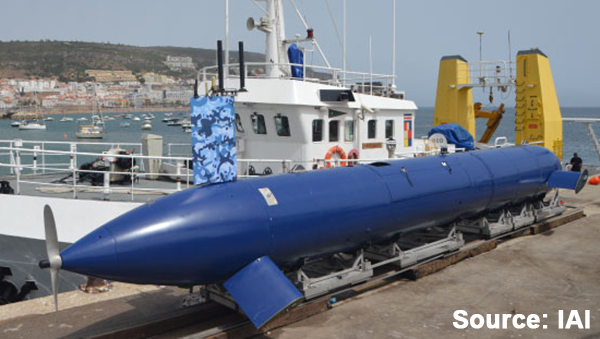
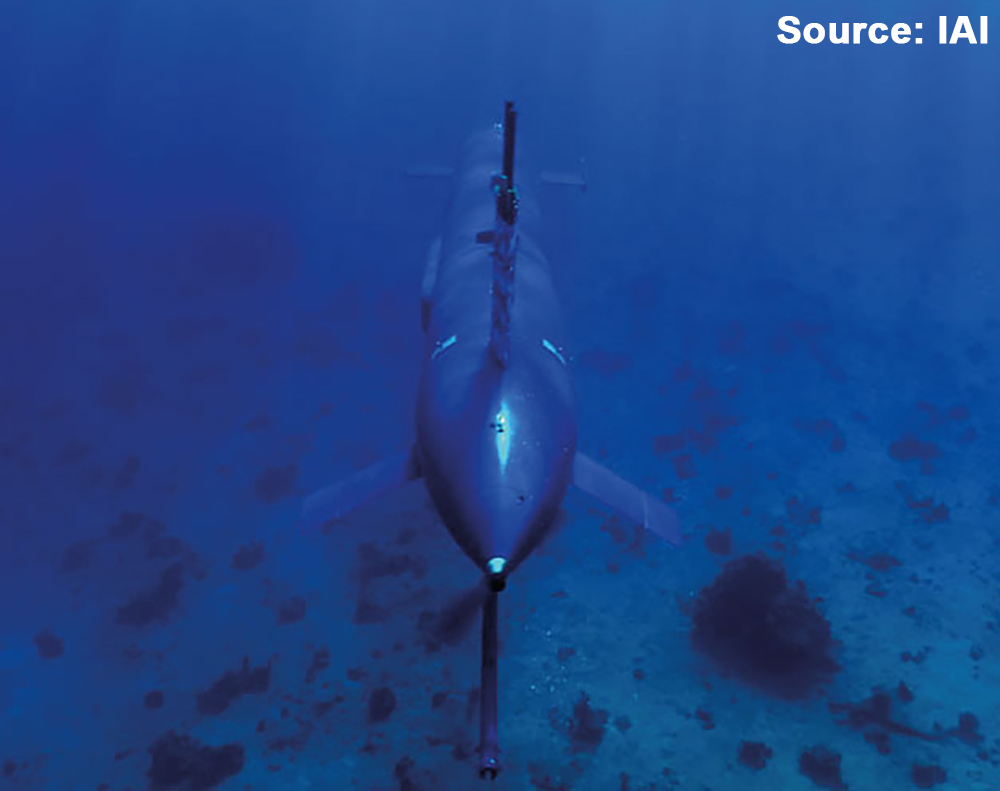
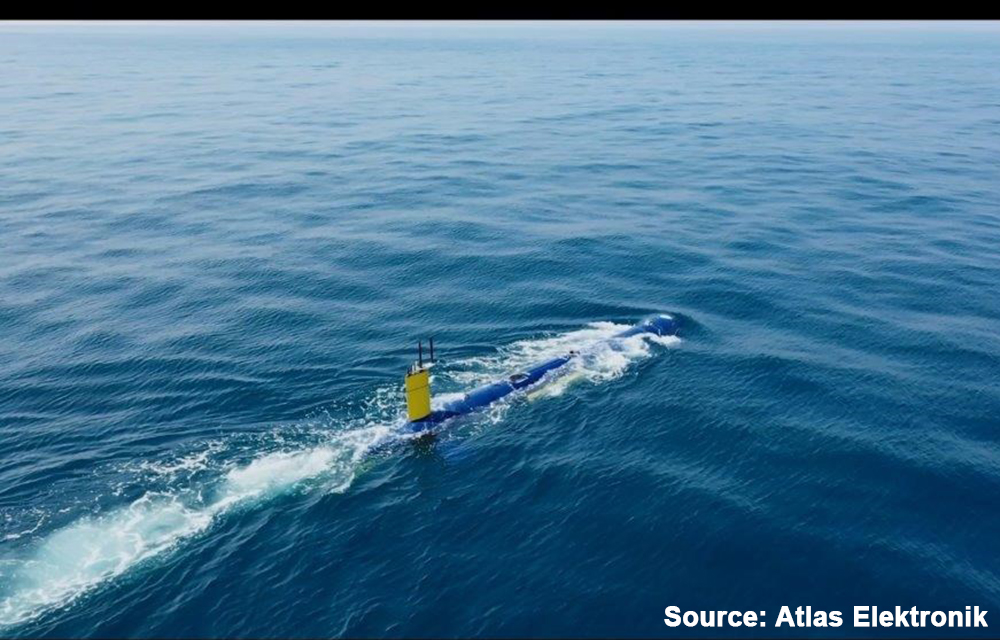
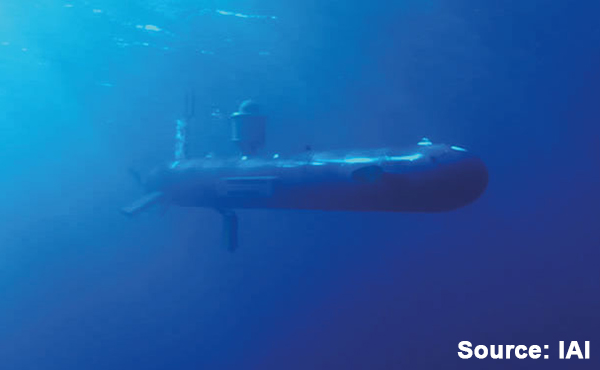
description
The BlueWhale is an Israeli large autonomous underwater vehicle (LAUV) developed by ELTA Systems Ltd., a subsidiary of Israel Aerospace Industries (IAI). The unmanned submersible was developed as a cheaper alternative to crewed submarines. The system is capable of configuration to fulfill intelligence collection, reconnaissance, seabed warfare, counter-piracy, anti-terrorism, and smuggling interdiction missions.
The BlueWhale can be transported in a 40-ft (12-m) shipping container.
HULL: The BlueWhale design is similar to a miniaturized submarine. The system measures 35 ft 9 in (10.9 m) long, with a diameter of 3 ft 8 in (1.12 m). A collapsible telescopic mast contains multiple sensor systems. Pairs of stabilizing fins are located forward and aft.
ENGINEERING: When submerged, the BlueWhale can reach a speed of 7 knots. While surfaced, it can attain a top speed of 3 knots. It is capable of fully electric operation for 30 days at a time, relying on the integrated battery banks. The system has an operational depth of 984 ft (300 m).
SENSORS/ELECTRONICS: The BlueWhale is capable of being fitted with a variety of mission-specific sensor payloads. Among the available electronic payloads are the Atlas Active Towed Aray Sonar (ACTAS), a mine-detecting synthetic aperture sonar, active and passive flank array sonars, magnetic anti-mine sensors and an active electronically scanned array (AESA) radar. Each BlueWhale unit is equipped with broadband, low signature satellite communications (SATCOM) for data exchange and a radar electronics support measure (R-ESM) system. Other unnamed electro-optical, infrared and radar systems are equipped.
BlueWhale's onboard controller system manages sensors, communications and power systems independently. The system is capable of tracking both surface and sub-surface targets and conducting real-time data processing.
status
In production.
Only known to be in service with the Israeli navy.
Israeli Aerospace Industries (IAI) subsidiary ELTA Systems unveiled the BlueWhale large autonomous underwater vehicle on May 5, 2023. The system is believed to be derived from the Caesaron unmanned submersible unveiled by the Israeli Ministry of Defense in 2017. The BlueWhale's development and trialing process reportedly included thousands of hours of submerged operation, according to IAI.
On May 10, 2023, IAI and Germany's Atlas Elektronik announced a teaming agreement to equip the BlueWhale with an Atlas towed passive sonar triplet array. The new sensor was expected to enhance BlueWhale's ability to track submarines by expanding its detection range to greater depths. The sonar is believed to be a variant of the Atlas Active Towed Array Sonar (ACTAS).
BlueWhale was demonstrated for NATO navies at the Dynamic Messenger and Robotic Experimentation and Prototyping using Maritime Uncrewed Systems (REPMUS) exercises in September 2023.
The German navy conducted intensive trials with the BlueWhale in the Baltic Sea for two weeks in November 2024. The service is reportedly considering procuring the system, however, no contract has been publicly revealed.
On May 7, 2025, IAI signed a Memorandum of Understanding (MoU) with Greece's Hellenic Aerospace Industry (HAI) at the DEFEA defense exhibition in Athens. The two companies agreed to market the BlueWhale AUV to the Hellenic Navy.
IAI reportedly failed to secure a BlueWhale joint work and export deal with Italy, according to Forecast International.
builders
ELTA Systems Ltd., Ashdod, Israel
users platforms
 Israel
   Navy
characteristics
 DISPLACEMENT
   Full load               5.5 tons

 DIMENSIONS
   Length                  35 ft 9 in (10.9 m)
   Diameter                 3 ft 8 in (1.12 m)

 PERFORMANCE
   Speed
      submerged            7 knots
      surfaced             3 knots
   Endurance               30 days
   Maximum depth           984 ft (300 m)

 SENSORS/ELECTRONICS
   Sonars                  1 x Atlas Active Towed Array Sonar (ACTAS) (optional)
                           1 x Synthetic aperture (optional)
                           1 x Active flank array (optional)
                           1 x Passive flank array (optional)
   Radars                  1 x Active electronically scanned array (AESA)(optional)
   EW                      1 x Radar Electronic Support Measure (R-ESM)
program cost
A specific price for the BlueWhale is unavailable, however Forecast International estimates each unit could cost more than $10 million.
variants alternative
Also designated ELI-3325.