
TAMANDARE (F-200) class
Country of Origin: Brazil

ship list
0 (+4) TAMANDARE-class FRIGATES (FF) (MEKO A-100 design)
 Name                       Pennant     Launched      Commissioned     Status
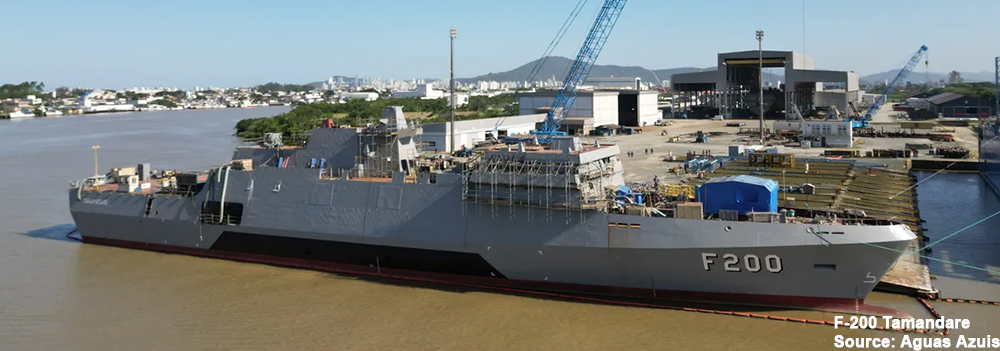
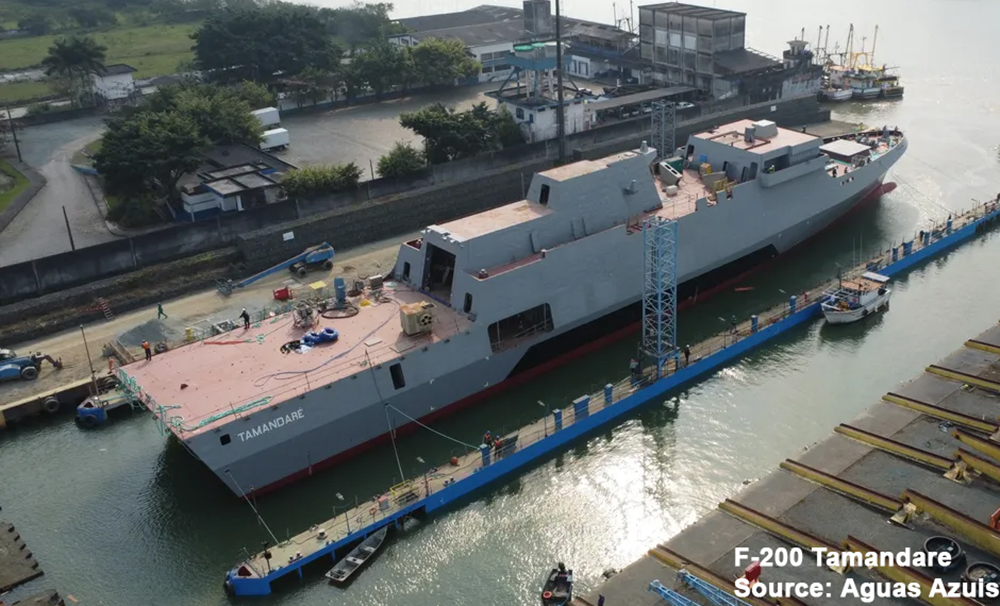
 TAMANDARE                  F-200       Aug. 9, 2024  ...              Fitting Out
 JERONIMO DE ALBUQUERQUE    F-201       ...           ...              Building
 CUNHA MOREIRA              F-202       ...           ...              Building
 MARIZ E BARROS             F-203       ...           ...              Ordered
description
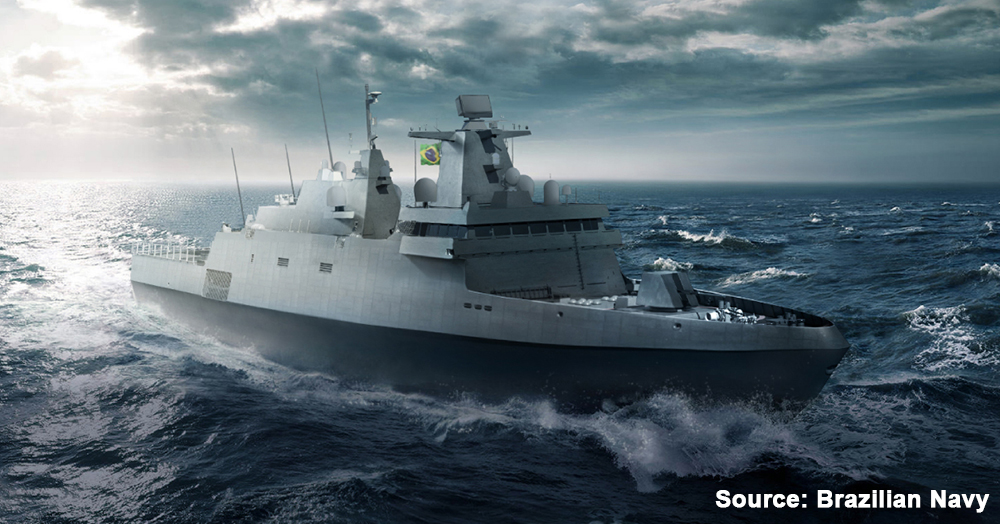
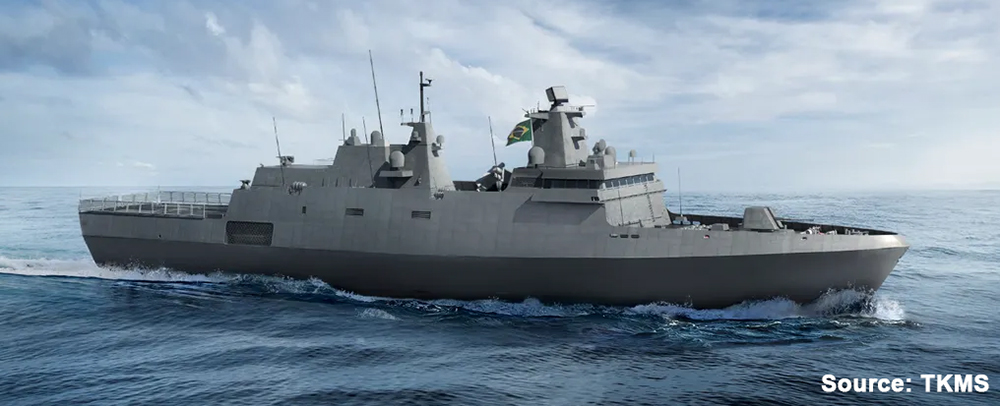
The TAMANDARE class is a series of incoming Brazilian frigates based on the German MEKO A-100 design. These ships are designed for escort duties, patrol, sovereignty enforcement, search and rescue, counter-piracy, fisheries protection and pollution control.
HULL: These ships are designed with stealth characteristics intended to reduce radar cross-section and detectability. The class measures 351 ft 8 in (107.2 m) long with beams of 52 ft 4 in (15.95 m) and drafts of 17 ft 1 in (5.2 m). At full load, they displace 3,800 tons.
A helicopter landing pad is installed aft. Two rigid-hull inflatable boats (RHIBs) can be carried.
The maximum crew complement is 136.
ENGINEERING: A Combined Diesel and Diesel (CODAD) propulsion configuration is implemented. Four MAN V12 28/33D diesel engines and four Caterpillar C32 diesel generators produce 28,934 total bhp. Two shafts and two controllable-pitch propellers are also fitted.
These ships can attain a top speed of 25 knots and a cruising speed of 14 knots. They can reach a maximum range of 5,500 nm (10,185 km).
ARMAMENT: These vessels are capable of handling a medium helicopter such as the S-70B Seahawk or H225M Caracal. The ships can also embark an Insitu ScanEagle unmanned aerial vehicle (UAV).
As part of the Sea Ceptor air defense system, 12 vertical launch system (VLS) cells are installed, armed with 48 Common Anti-Air Modular Missile (CAMM) missiles capable of being fired to a distance of 13.5 nm (25 km). Two quad-packed Mansup anti-ship missile launchers are fitted.
An Oto Melara 76-mm Super Rapido main gun is positioned on the forecastle. One 30-mm Rheinmetall SeaSnake 30 close-in weapons system (CIWS) is installed. Two Sea Defender remote weapons stations are fitted, each equipped with a 12.7-mm machine gun.
Two 533-mm torpedo tubes are installed, carrying an unknown number of Mk. 46 torpedoes.
SENSORS/ELECTRONICS: Hensoldt's TRS-4D active electronically scanned array (AESA) surveillance radar is installed atop the main mast. An Anschutz NSX is the primary navigation radar. Thales provides the Separate Tracking and Illumination Radar (STIR) 1.2 electro-optical fire control radar.
Two Safran Paseo extra-long range (XLR) optronic sights provide enhanced situational awareness and visibility to the frigates. Omnisys provides the MAGE Defensor electronic warfare support measurement system.
Atlas Elektronik supplies the ASO-713 hull-mounted sonar.
status
Under construction.
First hull expected to enter service in 2025.
The Brazilian Navy initiated the Programa Fragatas Classe Tamandare (PFCT) program in 2017 with a tender for new stealth frigates. The initial solicitation included offerings from Damen Saab, FLV, Villegagnon (a consortium of Naval Group, Mectron and Enseada shipyard) and Aguas Azuis (a consortium of ThyssenKrupp Marine Systems, Atlas Elektronik, Embraer and Atech).
On March 27, 2019, Aguas Azuis was selected as Brazil's preferred bidder, and a contract was signed on March 5, 2020.
On June 17, 2021, MBDA received a contract to equip the TAMANDARE class with its Sea Ceptor surface-to-air missile system. The Sea Ceptor is a weapon control system which, when coupled with the Common Anti-Air Modular Missile (CAMM), provides advanced air defense capabilities. The system was originally selected for integration in November 2014.
The lead ship, TAMANDARE, was laid down on March 24, 2023. The ship was launched at the Aguas Azuis shipyard in Itajai on Aug. 9, 2024. Sea trials are planned for July 2025 and delivery is anticipated by the end of the 2025.
The second frigate, JERONIMO DE ALBUQUERQUE, was laid down on June 6, 2024. Launch is expected in August 2025, with delivery planned for January 2027.
CUNHA MOREIRA was laid down on June 5, 2025. The ship is planned for launch in July 2026 and expected to enter service in February 2028.
The final frigate, MARIZ E BARROS is expected to have its keel laid in October 2026. Commissioning is planned for February 2029.
Naval News reported on Feb. 21, 2025, that UAE-based company EDGE Group had announced a contract award from the Brazilian navy to its subsidiary SIATT. The Brazil-based entity had been selected to supply Mansup anti-ship missiles to the TAMANDARE class. The number of missiles contracted as well as the value of the deal were not publicly disclosed.
Brazil is reportedly planning procurement of a second batch of TAMANDARE-class frigates, however no deal has, as of yet, been struck. A future order would likely cover two to four new hulls.
builders
Aguas Azuis Shipyard, Itajai, Santa Catarina, Brazil
characteristics
 CREW
   Total                   136

 DISPLACEMENT
   Full load               3,800 tons

 DIMENSIONS
   Length                  351 ft 8 in (107.2 m)
   Beam                     52 ft 4 in (15.95 m)
   Draft                    17 ft 1 in (  5.2 m)

 PROPULSION
   Main                    CODAD:
                           4 x MAN V12 28/33D diesel engines
                           4 x Caterpillar C32 diesel generators
      power                28,934 total bhp; 2 shafts; 2 controllable-pitch propellers

 PERFORMANCE
   Speed
      maximum              25 knots
      cruising             14 knots
   Range                   5,500 nm (10,185 km)

 COMBAT SYSTEMS
   Helicopters             1 x S-70B Seahawk or H225M Caracal
   UAV                     1 x Insitu ScanEagle
   Missiles                1 x Sea Ceptor air defense system
                           12 x VLS system [48 CAMM missiles carried]
                           2 x quad-packed Mansup anti-ship missile launchers
   Guns                    1 x Oto Melara 76-mm Super Rapido naval gun
                           1 x 30-mm SeaSnake 30 close-in weapons system
                           2 x 12.7-mm Sea Defender remote weapons system (RWS)
   Torpedo tubes           2 x triple 533-mm tubes [Unknown no. Mk 46 torpedoes carried]
   Radars                  1 x Hensoldt TRS-4D AESA surveillance
                           1 x Anschutz NSX navigation radar
   Fire control            1 x Thales STIR 1.2
   EO                      2 x Safran Paseo XLR optronic sights
   Sonars                  1 x Atlas Elektronik ASO-713 hull-mounted
   EW                      1 x MAGE Defensor ESM
issues and notes
Construction was originally scheduled to begin in April 2022, but was pushed back to September due to issues validating construction methods at the shipyard, which delayed the class' entry into service.
program cost
The first batch of four frigates were ordered under a $1.7 billion contract.
variants alternative
Modified German MEKO A-100 design.