
Swedish Industry Eyes NATO Boost
Author: Tom Freebairn
February 15 2023
Alliance membership offers new opportunities for Swedish firms.
Russia’s unprovoked invasion of Ukraine in February 2022 has shaken up the European security order. The ongoing war has forced NATO to re-evaluate its priorities as well as revealing shortcomings in the defense policies of many of its member states. It has spurred longtime partners Finland and Sweden to seek membership. While both countries have long been nonaligned, they have been working to integrate with European security via the NATO Partnership for Peace (PfP) program (both joined in 1994) and membership in the European Union (both acceded in 1995). There have been ongoing debates about joining the Atlantic alliance since; Russia’s invasion ended those, and Helsinki and Stockholm submitted simultaneous applications for NATO membership on May 18, 2022.
The transition, once the political hurdle of obtaining approval from all 30 member states is overcome, is not expected to be difficult. The Nordic countries have previously worked to bring their forces in line with NATO standards. Membership may also bring new opportunities, particularly for Sweden and its advanced defense industry.
Sweden developed advanced engineering and technical capabilities to support its independent defense policy and provide all its equipment needs. While it has had some success in exporting weapons, including light anti-tank weapons, armored vehicles and fighter jets, NATO membership offers new opportunities. With the war in Ukraine demonstrating the need for large amounts of materiel, weapons and ammunition, Swedish industry may be well-positioned to take advantage.
Charting an Independent Path
Sweden’s longstanding Alliansfrihet, or military nonalignment, policy has not meant neutrality or unpreparedness. Instead, Stockholm has emphasized self-reliance, maintaining a full range of military capabilities and the industry to support them. Sweden has also taken part in a variety of international operations, including the Balkans in the 1990s, Afghanistan from 2001 to 2021, Mali and fighting ISIS and training troops in Iraq. As a NATO member state, Swedish forces can be expected to further integrate with alliance missions, while gaining greater access to its capabilities for national defense.
An important part of Sweden’s nonalignment policy has been the development of a robust defense industry. Flagship firm Saab oversees subsidiaries involved in the aerospace, missile, electronics and sensor and naval domains. BAE Systems Hagglunds and BAE Systems Bofors build vehicles and various guns and munitions, respectively.
A modern and sophisticated economy supports cutting-edge industry. The E.U.’s European Innovation Scoreboard ranks Sweden first overall, with research and development cited as particular strengths. Unlike many of its future allies, Sweden produces advanced submarines, combat aircraft, missiles and surface warships.
As it looks to join the alliance, the government of Prime Minister Ulf Kristersson, which came to power in October 2022 on a platform calling for increased military readiness and investment, has pledged to increase defense spending to 2 percent of gross domestic product (GDP) by 2026 to meet NATO guidelines. This comes alongside a wider European commitment to upgrade defenses in response to Russia’s aggression in Ukraine.
Saab Bets Big
Saab continues to be the face of Swedish defense industry. In 2020, the top four Swedish defense contractors were Saab subsidiaries. The company, like its government, sees opportunity in NATO membership. In anticipation, it has scaled up production, hired new staff and developed plans to expand operations outside of Sweden.
CEO Micael Johansson has been open about the opportunities NATO membership offers to Saab and the Swedish defense sector as a whole: “You become part of the inner circle,” he said in an interview.
Membership would enable Swedish companies to compete more effectively for contracts in allied states. The shared affiliation would also allow companies like Saab to take on work in more sensitive areas such as data-handling and classified projects on advanced systems.
Johansson has bet that Saab will be able to leverage its diverse capabilities to contribute to the massive resupply efforts NATO countries are undertaking. According to a Financial Times article from April 2022, the company has garnered interest as a potential candidate to help restock shrinking weapon stockpiles.
As NATO members ratchet up military spending and send sizeable amounts of equipment to Ukraine, Saab is working to bolster its capacity to supply replacements and integrate with NATO industry. European countries have indicated a readiness to spend more on collective security. Under an agreement inked in December, the E.U. will allocate 500 million euros (US$535 million) beginning in 2024 for common defense procurement.
U.S. Navy Seen as Key Customer
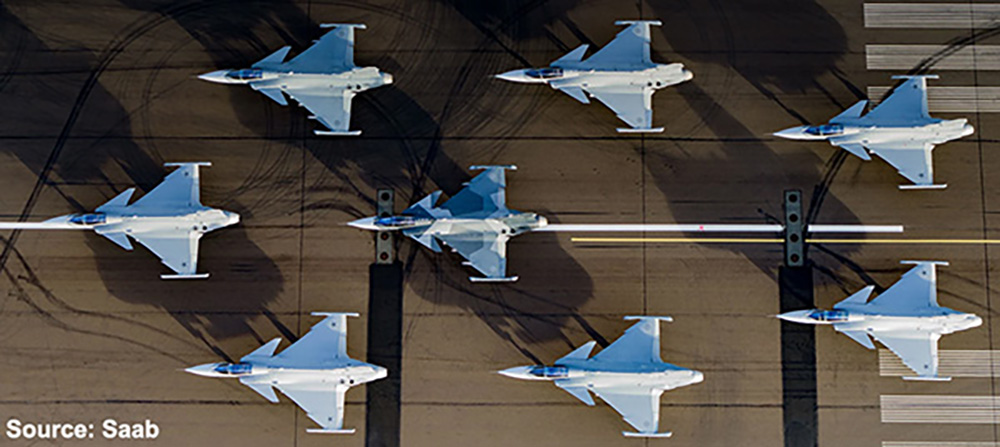
Sweden is preparing to join NATO’s Baltic air-policing mission with its Gripen fighters, offering another chance for Saab to show off its advanced aircraft. The Gripen is not new to NATO, having been in service with Czechia and Hungary since the mid-2000s. Sweden has long touted the type for NATO missions, citing its low maintenance, high-efficiency and short-takeoff-and-landing (STOL) capabilities.
NATO membership is expected to spur additional Swedish defense spending, including more investment in domestic industry. Between this spending and greater access to the NATO market, domestic defense firms may have more opportunities to expand their markets.
Saab’s commitment to expanding further into NATO markets is underscored by the announcement of its new Autonomous and Underseas Systems division in Cranston, R.I. The 10,000 square-foot (930 square-meter) facility is near the U.S Naval Undersea Warfare Center.
Saab representatives at the Surface Navy Association Symposium in Arlington, Va., in January told Military Periscope that the company was excited to be making inroads into the U.S and saw it as a key market. The Navy was highlighted as a priority customer for Saab’s expanding operations. The company has previously sold its Giraffe radars to the U.S. Coast Guard and Navy.
Challenges Both International…
While Sweden and its defense industry may have reason for optimism, there remain obstacles before it can realize its potential within the NATO industrial space.
The first is the ongoing obstruction of its accession. Hungary and Turkey have so far declined to approve the Finnish and Swedish applications. Turkish President Recep Tayyip Erdogan has sought to use its current leverage to push Sweden to reduce its support for Kurdish groups in Syria. It has also demanded the extradition of alleged members of the banned Kurdistan Workers’ Party (PKK), which has been engaged in armed struggle against the Turkish government since 1984. Sweden has already agreed to resume arms sales to Turkey, following a ban introduced after Ankara’s 2019 invasion of the Kurdish enclave in northern Syria.
The situation was further inflamed on Jan. 21 when Danish far-right politician Rasmus Paludan burned a copy of the Koran outside the Turkish Embassy in Stockholm during a protest. The event sparked condemnation from Turkish authorities including President Erdogan. The act was protected under Swedish free speech laws. A subsequent anti-NATO rally in Stockholm planned for early February that would have involved the burning of another Koran was not approved by authorities, who said the previous demonstration had increased the risk of attacks against Sweden and Swedish interests abroad.
Turkish resistance has proven difficult to overcome but that could change after general elections set for June 18. Some have suggested that Erdogan is taking a hardline stance to demonstrate his credentials as a strong leader and religiously minded politician. If he wins re-election, he may be more amenable to approving Swedish accession. Should the opposition win, a possibility amid widespread criticism for economic failures and a deadly earthquake on Feb. 6 that killed tens of thousands in Syria and Turkey, it is expected to be generally supportive of Swedish membership.
…And Domestic
On the industrial front, Swedish legislation may inhibit domestic companies seeking to expand their exports. Swedish laws, designed during decades of military nonalignment, are not geared for significant military exports or collaboration with allied firms.
Under Sweden’s Military Equipment Act, all sales must have a security or defense policy rationale and cannot conflict with international obligations or foreign policy. Swedish defense companies have already begun lobbying for reforms, promoting legislation that they say would give domestic firms an edge on the export market.
There are also concerns that NATO membership could have unintended effects on Swedish defense industry. The agreements that would enable Swedish companies to better compete for work outside the country would also allow foreign companies to compete for Swedish contracts.
Saab CEO Johansson has acknowledged arms export reforms and NATO membership could lead to greater competition at home but insisted that this would not have a negative effect on Saab. As of October, the company was working through a US$11.7 billion order backlog.
Government support for domestic defense industries will determine how deep external companies can penetrate the Swedish military procurement sphere. While initial support is bound to be strong, down the road Sweden could find it more advantageous to abandon its own big ticket naval and aircraft programs in favor of collaborative projects with other countries, or procurement of foreign systems.
The security climate has made Swedish nonalignment increasingly untenable. Recognizing this, Swedish political and industry leaders are seeking to take advantage of these changes to better secure the country within NATO and strengthen domestic industry.
If Sweden successfully navigates the political and industrial challenges it faces as it seeks to join NATO, it may secure its place in Europe as a security contributor through both its military and advanced industrial capabilities.
Sources:
“European Innovation Scoreboard,” Hugo Hollanders, Nordine Es-Sadki and Aishe Khalilova, European Commission, Oct. 20, 2022; “Growing majority of Swedes back joining NATO, opinion poll shows,” Reuters, April 20, 2022; “Joint Communication to the European Parliament, the European Council, the Council, the European Economic and Social Committee and the Committee of the Regions on the Defence Investment Gaps Analysis and Way Forward,” European Commission, May 18, 2022; “Saab Announces New Autonomous and Undersea Systems Division in New U.S. Production Facility,” Saab, April 4, 2022; “Saab anticipates fresh opportunities if Sweden joins NATO,” Richard Milne, Financial Times (U.K.), April 23, 2022; “Saab CEO Says Swedish NATO Entry Would Open Door to Inner Circle,” Veronica Ek, BNN Bloomberg, April 22, 2022; “Saab Ramping Up Capacity Ahead of Sweden’s NATO Membership,” Rafaela Lindeberg, Bloomberg News, Oct. 28, 2022; “Strategic Export Controls in 2020 – Military Equipment and Dual-Use Items,” Stefan Löfven, Swedish Ministry of Foreign Affairs, April 8, 2020; “Sweden has a chance to transform European security—even before it officially joins NATO,” Franklin Kramer, Atlantic Council, Jan. 30, 2023; “Sweden’s Challenging Road To NATO Membership,” Nama Karl-Thomas Habtom, Lawfare, Jan. 17, 2023; “Sweden’s Role in NATO,” Ulf Kristersson, Government Offices of Sweden, Jan. 9, 2023; “Swedish defense industry bosses eye NATO business dividend,” Gerard O’Dwyer, Defense News, Jan. 18, 2023; “Why Gripen is an Ideal Choice for NATO Missions,” Saab, Aug. 21, 2020.